
FuseGov installs as a proxy in the call path. Every AI request from any IDE, CLI, agent framework, or CI job is redacted, policy-checked, budgeted, and sealed before it reaches a provider. Developers redirect one base URL. Nothing else about their workflow changes.
PII detected and redacted; the cleaned prompt is checked against your policy store before any inference cost is incurred. Hard-block matches stop here.
FuseSense checks the task's budget synchronously. Over limit → rejected with a clear error until a manager approves an increase.
Citations verified against live sources and archived; the response is checked for conflicts with your internal policies.
A composite risk score routes low-risk responses through automatically and holds high-risk ones for a reviewer with a full evidence package.
The full interaction manifest is hashed and signed. The audit log is append-only at the database role level.
A budget system is only as trustworthy as its answer to one question: how does a raw HTTP call from an IDE know which task it belongs to? The Context Injection Gateway stamps every call with its task reference before dispatch resolved from the active git branch, an IDE selection, a CLI flag, or a CI parameter, in that order.
Fails open, but capped. Unattributable calls proceed — blocking developer work is how shadow AI starts — but draw from a small per-developer penalty pool, hard-blocked on exhaustion.
Coverage gap ≠ gaming. A developer whose surface isn't covered yet is flagged for expanded rollout; a developer whose unattributed rate spikes against their own baseline is flagged to their lead. Different problems, different responses.
Two deployment paths. A local shim per developer surface, plus a centralized HTTPS proxy fallback — so a silently broken IDE extension doesn't quietly turn all its traffic unattributed.
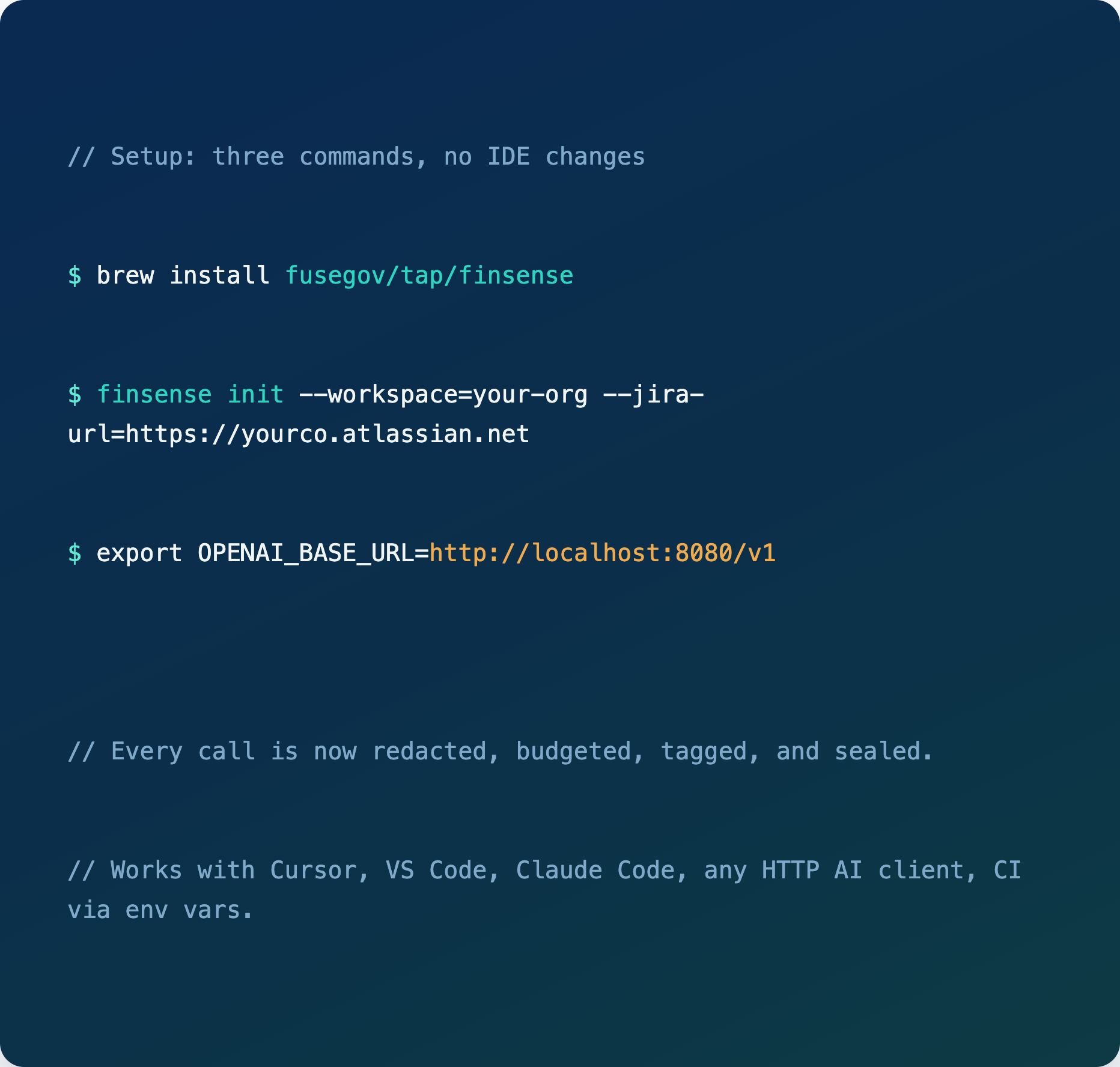
If it speaks HTTP to an AI provider, it can route through FuseGov. Tell us what you run and we'll confirm compatibility before you commit to anything.
.png)