
Platform

Two engines, one sealed record.

FuseGov decides whether an interaction is allowed and proves what happened. FuseSense decides what an interaction may cost and who approved it. Both write to the same append-only, cryptographically sealed audit log.
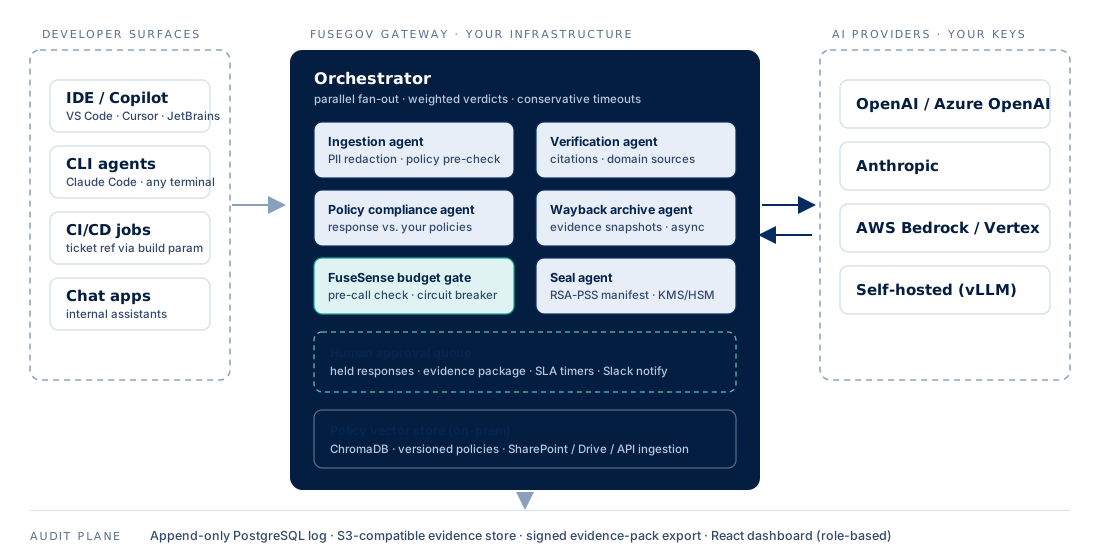
FuseGov · The governance engine

Enforcement on the interaction, not the org chart.

Every prompt and every response passes through a team of specialized enforcement agents coordinated by an orchestrator. Each does one job; the orchestrator combines their verdicts into a single risk score and routes the outcome.

PII detection & redaction

We monitor every AI agent interaction and prevent sensitive data from leaving your environment. Names, contact details, health record numbers, and financial identifiers are detected and redacted before an agent can send them externally. Detection runs on-premises using rule-based NER and a fine-tuned model, with no external API calls.

Human-in-the-loop routing

Responses above your risk threshold are held for a reviewer, who gets a complete package: redacted query, agent verdicts, matched policy text with version and effective date, and a per-component score breakdown. Approve, edit, reject, or escalate with SLA timers.

Observe-first deployment

Enforcement modes are staged: observe everything first, flag and review second, automate third. Policies support graduated actions hard block, soft warning, mandatory disclaimer, escalation so governance matches risk instead of stopping work.

FuseSense · The cost engine

Spend is gated before it happens and approved by a human.

Every AI call carries a task ID and is checked against that task's budget before it's dispatched. Costs are computed per call from live provider pricing, in USD not raw tokens, which stop meaning anything once multiple model tiers are in play.

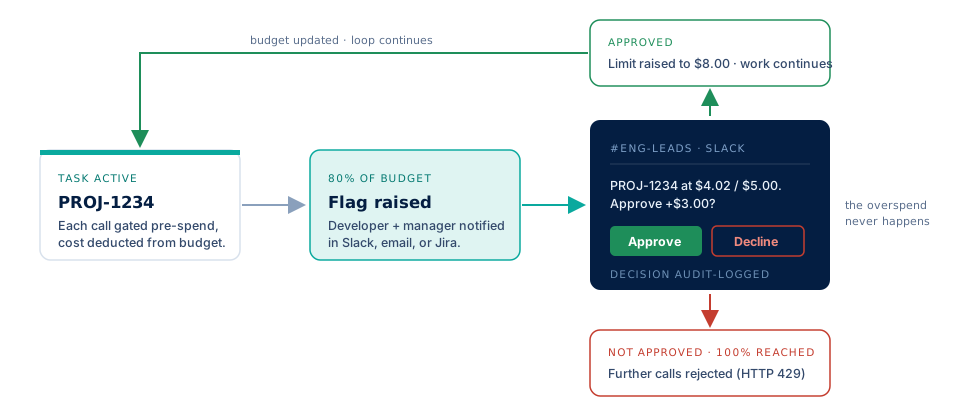
The approval loop

The mechanism that makes FuseSense different from a dashboard:

  • At 80% of budget, the developer and manager are notified  Slack, email, or a Jira comment.
  • A cost increase goes to the manager for approval. Approved: the limit rises and the adjustment is audit-logged. Not approved: it doesn't.
  • At 100%, further calls for that task are rejected  until a limit change is approved. The overspend never occurs.

Task-level budgets from your sprint board

Budgets attach to the work itself:

  • A Jira webhook creates a budget when a ticket is created; defaults are configurable per team.
  • Every call is stamped with its task ID at the network layer from the active branch name, an IDE selection, a CLI flag, or a CI parameter. No IDE plugins required.
  • Calls that can't be attributed aren't blocked  they draw from a small, capped per-developer penalty pool and are reported separately. Fail open, but capped.
Start building with us
OE logo2020INC logoThe Paak logoEphicient logo

Rate-of-spend circuit breaker

An autonomous agent stuck in a retry loop can burn a task's entire budget in minutes  faster than any human notification. The circuit breaker tracks cost and call count in a rolling 60-second window and freezes that specific task the instant a tripwire is exceeded. Freeze first, notify after. Declared batch jobs are exempt and governed by a hard total cap instead.

Routing that avoids false economies

Always picking the cheapest model is how you pay twice: a failed cheap call plus a retry on a stronger one. FuseSense routes on expected total cost to a successful outcome retries escalate one tier automatically, and persistent developer overrides feed back into calibration as a signal the default tier is wrong.

Want the full spec?

We publish real artifacts  schemas, decision trees, and the design-review risk log  because technical credibility should be inspectable, not asserted.